George Bertrand
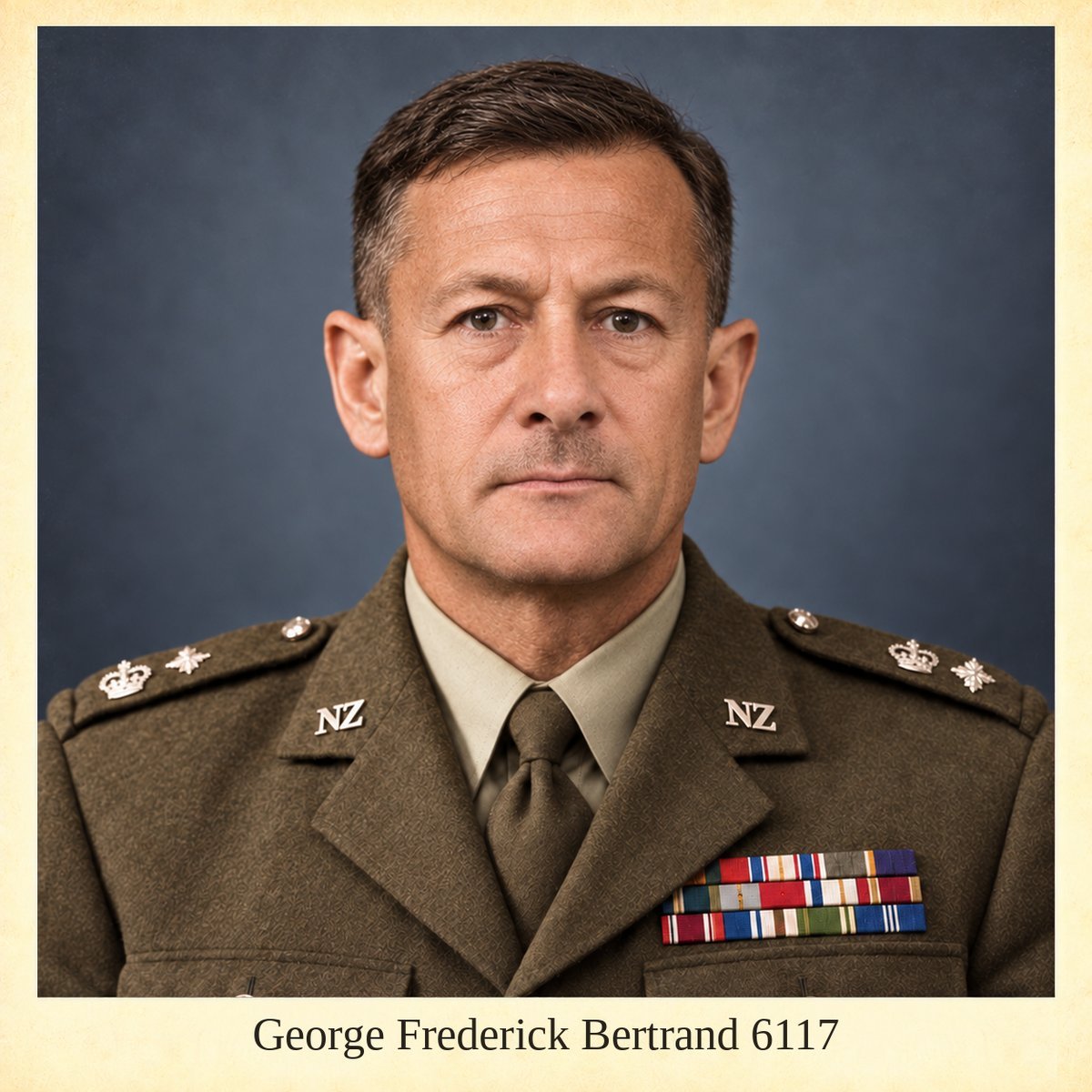
Lieutenant-Colonel 6117, OBE, ED · Second-in-command, 28th (Māori) Battalion, 1939–41
George Bertrand served at Battalion Headquarters. The Online Cenotaph lists him under D Company, and he is included here for his place in the battalion’s story.
Early life
George Frederick Bertrand was born at Urenui, Taranaki, on 9 February 1891. His father, George Bertrand, was an English immigrant, and his mother, Toroa Te Ikawairangi, was Ngāti Mutunga. He went to school at Urenui and then Te Aute College, where he passed the Civil Service Junior examination with credit among the top hundred in the country. He trained at Wellington Teachers’ Training College, gained a BA in Latin and history from Victoria College, and became a teacher with the Taranaki Education Board.
First World War
George enlisted on 13 August 1914 in the 11th (Taranaki) Company of the Wellington Battalion and sailed with the Main Body. At Gallipoli he was wounded twice, by bullets on 8 May 1915 at Krithia and by a shell splinter to the head on 8 August, the day the Wellington Battalion took Chunuk Bair. He rose to company sergeant major there, and in February 1916 he was commissioned in the field in Egypt. His service record has one small blot, from March 1915, when he was “late on parade” at Zeitoun and admonished.
George returned to New Zealand, sailed again with the 16th Reinforcements, and on the Western Front he was wounded a third time on 20 August 1917. In 1918 he commanded a company as a temporary captain. After a bout of trench fever he became a musketry instructor in England. During the war he changed his next of kin from his father to Miss K. Simpson of Wellington, and in January 1921 he married Kathleen Mary Rosborough Simpson.
Between the wars
George taught Latin, mathematics and history at New Plymouth Boys’ High School from 1920. He stayed in the Territorials, and in 1931 he became commanding officer of the Taranaki Regiment.
Second World War
In November 1939, aged 48, George was appointed second-in-command of the new 28th (Māori) Battalion. When it sailed in May 1940 he commanded the battalion on board the Aquitania. The convoy was diverted to Britain, and at Farnham he entered the battalion’s swimmers in a local carnival, where they won every event. In Greece he noticed old villagers gathering puha in the fields. On Crete he was sick in the 7th General Hospital when German paratroopers overran it, and he and about 300 patients were marched towards Galatas until a New Zealand patrol attacked their guards and set them free.
In late 1941 George was placed on the New Zealand roll and came home. He commanded the 2nd Māori Battalion and then the Māori Training Unit, which trained reinforcements for the 28th, including the Māori draft of the 12th Reinforcements in 1944. He was appointed OBE in the 1943 New Year Honours, and in October 1943 he was among the honoured guests at the investiture of Second Lieutenant Moana-nui-a-Kiwa Ngarimu’s Victoria Cross at Ruatoria. In 1945 he wrote proposing a Māori contingent for the war against Japan, and Sir Āpirana Ngata passed his letter on to the Army, describing him as “a good disciplinarian”. Japan surrendered the following month.
After the war
George returned to teaching, and he served on the Ngarimu Scholarship Fund Board and the executives of the RSA and Rugby Park. He died at Palmerston North on 25 July 1957, aged 66, the day after a car crash near Ōtaki, and he is buried at Te Henui Cemetery, New Plymouth. Four months later his granddaughter, Georgina Beyer, was born and named after him.
Sources
Online Cenotaph C38446; J. F. Cody, 28 (Maori) Battalion (1956); Archives New Zealand personnel file R24054495; Te Ao Hou, no. 22 (1958); London Gazette, 1 January 1943; Auckland Star, 6 October 1943; The Press, 29 July 1957; Wikipedia, ‘George Bertrand’.
Are you whānau? If you can add to his story, correct anything here or share a photograph, please get in touch.